Endoscopic treatments in Hauppauge offer a less invasive way to diagnose and treat certain spine and joint conditions. At MK Spine & Joint Rehab (Marvin Kalter Spine & Joint, P.C.), we combine image-guided outpatient procedures with rehabilitation and medication when needed. The goal is to help you get back to daily activities with less pain.
What Are Endoscopic Treatments?
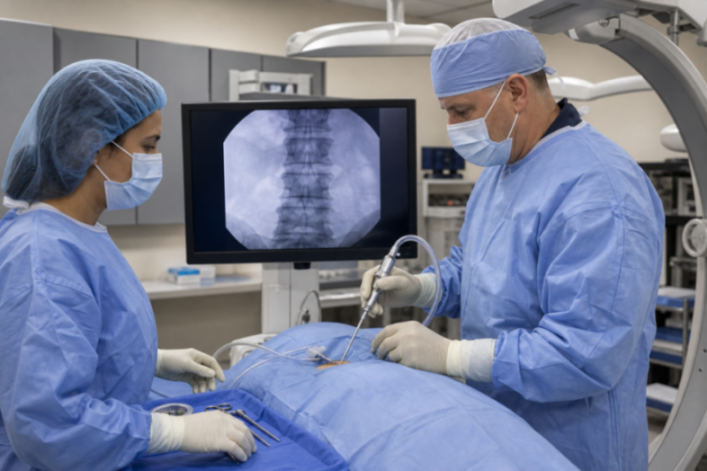
Endoscopic procedures use a thin tube with a small camera, called an endoscope, and specialized instruments that fit through tiny incisions. The camera gives the clinician a direct view of the area without having to disturb as much surrounding tissue as in open surgery. These techniques may be used for herniated discs, certain types of nerve compression, and some problems within a joint.
Common Conditions Treated With Endoscopy
We may consider endoscopy or another minimally invasive approach when symptoms haven’t improved with conservative care. Examples include:
- Herniated discs in the neck or lower back that irritate a nerve root (radiculopathy)
- Pain and degenerative changes in the facet joints of the spine
- Certain problems within a joint, such as the shoulder or knee
- Recurring pain after surgery, in select cases
How Endoscopic Procedures Fit Into a Multidisciplinary Plan
A procedure is usually just one part of the plan. Depending on what’s causing your pain, we may use medication management to address inflammation or nerve pain and recommend physical therapy or occupational therapy to help you move more comfortably and get back to everyday tasks. For some patients, image-guided epidural or facet injections or radiofrequency ablation may also be appropriate. We aim to ease pain and improve mobility without more invasive surgery when possible.
Procedures You May Hear About
Percutaneous Disc Decompression
For some people with a contained disc herniation, percutaneous disc decompression can relieve chronic back pain by lowering pressure inside the disc and easing nerve irritation. The procedure uses image guidance and requires only a small opening.
Endoscopic Discectomy and Decompression
In an endoscopic discectomy, the surgeon uses a small camera to see the disc material pressing on a nerve root and specialized instruments to remove it. Because less tissue needs to be exposed, recovery may be faster than after an open discectomy.
Radiofrequency Ablation (RFA)
Unlike endoscopic discectomy, radiofrequency ablation doesn’t remove disc material. It uses image guidance and heat to interrupt pain signals from small nerves, often those that carry signals from a facet joint. We typically consider RFA after a diagnostic nerve block helps confirm where the pain is coming from.
Benefits of Endoscopic and Minimally Invasive Approaches
In minimally invasive spine surgery, smaller incisions can mean less disruption to nearby muscles, less blood loss, and less pain after the procedure. Many procedures are done on an outpatient basis or require a shorter hospital stay. Depending on the procedure, you may also be able to return to everyday activities sooner and continue with rehabilitation or other nonsurgical care.
Those benefits aren’t the same for everyone. A thorough exam, a review of your imaging, and any needed diagnostic tests help us choose an approach that fits your condition.
Who Is a Candidate?
Whether an endoscopic procedure makes sense depends on your symptoms, diagnosis, imaging, and what you’ve already tried. It may be an option for adults with nerve pain from a contained disc herniation or certain joint problems that can be treated with a small camera. If testing points to a facet joint as the source of pain, we can also discuss other minimally invasive options, such as RFA.
At our Hauppauge office, we take a detailed history, perform a focused exam, and review MRI or CT scans or other imaging. We may also use nerve conduction testing when indicated. Our guide to how a herniated disc is diagnosed and treated explains how those findings can help guide your care.
What to Expect: From Consultation to Recovery
At your first visit, we’ll talk about your symptoms, review your imaging, and ask what’s helped so far and what hasn’t. If a procedure is an option, we’ll discuss its risks, what it might help you do more comfortably, and how it compares with continued conservative care or surgery. Understanding when to consider spine surgery and when nonsurgical care may be appropriate can help you prepare for that conversation.
Many endoscopic procedures are performed on an outpatient basis. The type of anesthesia depends on the procedure. Afterward, we’ll explain which activities you can resume and when, based on the area treated and your overall health. When you need help getting back to everyday tasks, physical therapy and occupational rehabilitation can be part of your recovery plan.
Risks and Limitations
Possible complications include infection, bleeding, nerve irritation or injury, and pain that doesn’t improve. Some patients may need another procedure. Endoscopy isn’t right for every condition: significant spinal instability or deformity may still require open surgery. We’ll discuss the risks and alternatives with you before recommending a treatment.
Why Choose MK Spine & Joint Rehab in Hauppauge
We’re a Long Island practice serving patients in Nassau and Suffolk counties. We coordinate outpatient treatment and rehabilitation so that the next step builds on what we’ve learned from your exam and prior care. Your plan may include medication, injections, or minimally invasive procedures such as RFA or percutaneous disc decompression. If a surgical opinion would help, we can refer you for a consultation.
Next Steps and Scheduling
If you’re dealing with ongoing or injury-related spine, nerve, or joint pain, you can contact us to schedule a consultation in Garden City or Hauppauge. Call the office or book online. At your visit, we’ll talk through your options and explain whether endoscopic treatment, rehabilitation, medication, or a combination makes sense for you.
Further Reading and References
The American Academy of Orthopaedic Surgeons and Cleveland Clinic offer patient-friendly explanations of minimally invasive spine surgery. These overviews can help you get familiar with the terminology and decide what you’d like to ask at your consultation.
Frequently Asked Questions
What are endoscopic treatments for spine and joint conditions?
These treatments use a small camera and specialized instruments inserted through tiny incisions to see and treat problems in the spine or a joint. They aim to disturb less tissue than open surgery and are often performed on an outpatient basis with image guidance.
Are endoscopic procedures safe?
Endoscopic procedures are generally safe when performed by experienced clinicians, but they aren’t risk-free. Possible complications include infection, bleeding, nerve irritation, and persistent symptoms. Your provider will explain the risks and alternatives for your particular condition.
How long is recovery after an endoscopic spine procedure?
Recovery depends on the procedure and your overall health. Many people recover sooner than they would after open surgery. You may be able to resume light activities within a few days to a few weeks, then gradually do more with guidance from your care team.
Which conditions are best treated with endoscopic techniques?
Endoscopy may be appropriate for a contained disc herniation that’s causing nerve pain, some types of facet joint pain, or certain other joint conditions. Your exam, imaging, and response to earlier treatments help determine whether it’s a good fit.
Will endoscopic treatment eliminate the need for physical therapy?
Not necessarily. A rehabilitation plan can help you regain strength, flexibility, and comfortable movement. We discuss what physical therapy you may need as part of planning your recovery.
Do you offer other minimally invasive options besides endoscopy?
Yes. MK Spine & Joint Rehab offers image-guided, minimally invasive options including epidural and facet injections, radiofrequency ablation, percutaneous disc decompression, spinal cord stimulation, and pain pumps.
How do I schedule a consultation to discuss endoscopic treatments?
You can book online or call to schedule a visit in Garden City or Hauppauge. During your consultation, we’ll review your imaging, discuss whether more testing would help, and explain which options are worth considering.