Spine, nerve or joint pain can make it harder to get through a workday or enjoy time with your family. At MK Spine & Joint Rehab (Marvin Kalter Spine & Joint, P.C.), our Hauppauge team takes the time to understand what’s causing your pain and how it affects your life. Depending on what we find, your outpatient care plan may include nerve testing, medication management, physical or occupational rehabilitation, or image-guided procedures to help you get back to the activities that matter to you.
What to expect at your Hauppauge consultation
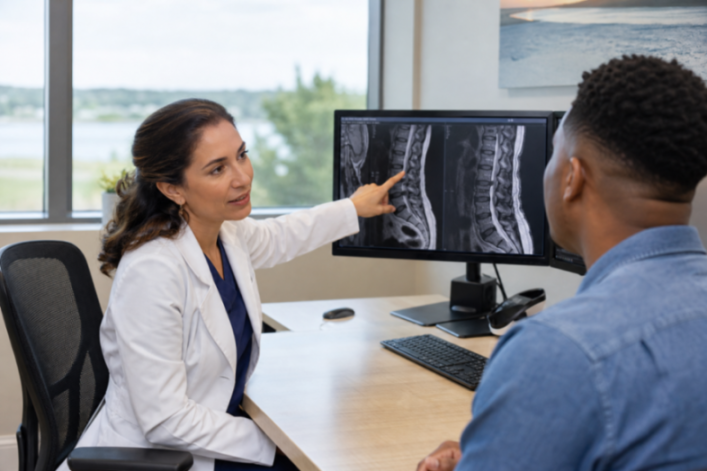
At your first visit, we’ll ask about your symptoms and medical history and perform a focused physical and neurologic exam. We’ll review any imaging you already have and arrange updated studies if they’re needed to help identify the source of your pain. From there, we can talk through a plan that addresses both pain relief and what you’d like to be able to do again.
Multidisciplinary assessment
Our pain management physicians work with therapists and nurses to coordinate your care. That might mean adjusting medication as you begin an exercise program or using test results to decide whether a targeted procedure makes sense. We take your other health conditions and activity goals into account as the plan evolves.
Advanced diagnostic testing: nerve conduction studies and EMG
Electrodiagnostic testing can help us tell whether your symptoms come from a compressed nerve, peripheral neuropathy or a muscle disorder. We perform nerve conduction studies and electromyography (EMG) in the office when indicated, so we can use the results to guide your next steps.
Outpatient, image‑guided minimally invasive procedures
For some patients, a targeted procedure can relieve pain without open surgery. We use fluoroscopy or ultrasound to guide many of these procedures, helping us place the needle or instrument accurately and safely.
Common image‑guided options
- Epidural and facet injections: Depending on the medication and the area treated, spinal epidural and facet injections can reduce inflammation. A facet joint block can also help us tell whether pain is coming from that joint.
- Radiofrequency ablation (RFA): When pain comes from a facet joint, radiofrequency ablation can interrupt pain signals carried by the nerves that serve the joint.
- Percutaneous disc decompression: For some patients with a contained disc herniation, percutaneous disc decompression can ease pressure on a nerve without open surgery.
- Spinal cord stimulation and pain pumps: If pain persists despite other treatments, we may evaluate whether a spinal cord stimulator or an implanted intrathecal pain pump is appropriate. If stimulation is an option, we can explain how a spinal cord stimulation trial works in Hauppauge before you decide about an implant.
- Joint injections and Botox for chronic migraine: Targeted joint injections can relieve pain from arthritis or other joint problems. We also offer Botox for chronic migraine when clinically appropriate.
Medication management within a broader plan
Medication can ease pain, help you sleep better and make it easier to take part in rehabilitation. As part of medication management, we regularly review what’s helping and what risks to watch for. The goal is to support what you’re doing in therapy, not replace it.
Rehabilitation to restore function
Physical therapy and occupational rehabilitation help you build on the relief you get from medication or a procedure. In our Hauppauge rehabilitation programs, exercises progress as you’re able. Depending on your goals, you might work on posture and how you move, build core stability or practice movements you need for everyday activities. Addressing movement problems can also help keep symptoms from returning.
Why outpatient care matters
Many of our procedures are done on a same-day basis, so you can recover at home and get back to work and family responsibilities as your recovery allows. Outpatient care doesn’t end when you leave the office. We’ll check how you’re doing and adjust the plan if you’re not making the progress we expect.
Who may benefit from our services
We see adults with chronic low back or neck pain, radiculopathy (pain from a nerve root), peripheral neuropathy, and joint pain from arthritis or injury. We also evaluate pain that persists after surgery, work and sports injuries, and chronic migraine. If you’re looking for a second opinion or want to know whether there’s a nonsurgical option, we’re happy to talk it through.
Safety, informed consent and realistic expectations
Before you decide on a treatment, we’ll explain the potential benefits, the risks and what you can realistically expect. Many patients have less pain and find it easier to move or manage daily tasks, but results vary. No treatment can guarantee that your pain will go away completely.
Scheduling and locations
MK Spine & Joint Rehab serves Long Island from offices in Garden City and Hauppauge. You’ll find directions and contact details on our Hauppauge office page. If Nassau County is more convenient, you can visit our Garden City office page for location details. You can book online or call to schedule at either office.
Working with referring providers
We work with primary care physicians, orthopedists, neurologists and occupational medicine specialists. We share reports with referring providers and coordinate next steps as patients move between conservative care, procedures and rehabilitation.
Patient resources and next steps
Our patient resources can help you prepare for your first appointment, and our practice overview explains who we are and how we work. If you’re weighing minimally invasive procedures, our guide to interventional spine care explains how different procedures can fit into a pain relief plan.
Evidence and trusted guidance
Chronic pain care often works best when it combines several approaches rather than relying on one treatment alone. Depending on your needs, that may include education, active rehabilitation, carefully managed medication or a targeted procedure. If we recommend nerve and muscle testing, the American Association of Neuromuscular & Electrodiagnostic Medicine explains what to expect during nerve conduction studies and EMG and how to prepare.
Make an appointment
If pain is getting in the way of your daily routine, book online or call to schedule a consultation in Hauppauge or Garden City. We’ll start by listening to what’s changed for you and talk through the options that fit your goals.
Frequently Asked Questions
What types of conditions do you treat at the Hauppauge office?
We treat adults with chronic and injury-related spine, nerve and joint pain. That includes low back and neck pain, radiculopathy, peripheral neuropathy, arthritic joint pain, pain after surgery, work and sports injuries, and chronic migraine.
Do I need imaging before my first visit?
If you have recent imaging, such as an MRI, CT scan or X-rays, bring it to your appointment. If you don’t have imaging or it’s out of date, we may arrange new studies if they would help us make a diagnosis or plan your care.
What is electrodiagnostic testing, and why might I need it?
Nerve conduction studies and EMG show how well your nerves and muscles are working. The results can help us tell whether nerve compression or neuropathy is causing your symptoms and guide treatment. We perform these tests in the office when needed.
Are the procedures you offer performed on an outpatient basis?
Yes. Many procedures, including image-guided epidural and facet injections, radiofrequency ablation, percutaneous disc decompression and certain neuromodulation trials, are done on an outpatient basis with same-day recovery protocols.
How does medication management fit into my overall care?
Medication can reduce pain, improve sleep and make it easier to participate in therapy. We’ll review your medications regularly for safety and effectiveness and consider how they fit with rehabilitation and any procedures you’re receiving.
What should I expect after a minimally invasive procedure?
Recovery depends on the procedure, but most patients go home the same day after a brief period of observation. We’ll explain what to do at home, when to follow up and whether rehabilitation is recommended.
How do I schedule an appointment at the Hauppauge office?
Call our office to schedule an appointment. You’ll find the phone number and directions on our Hauppauge office page.
Trackbacks/Pingbacks