Compassionate, Board-Certified Pain Care in Hauppauge
If you live in Hauppauge or elsewhere on Long Island and are dealing with chronic spine, nerve or joint pain, a board-certified pain management doctor can help you find a safe, evidence-based path to improved function. MK Spine & Joint Rehab (Marvin Kalter Spine & Joint, P.C.) provides multidisciplinary, non‑surgical and minimally invasive care at outpatient offices serving Suffolk and Nassau Counties. Our approach emphasizes individualized evaluation, diagnostic testing, medication management, rehabilitation and targeted, image‑guided procedures.
How our team evaluates pain
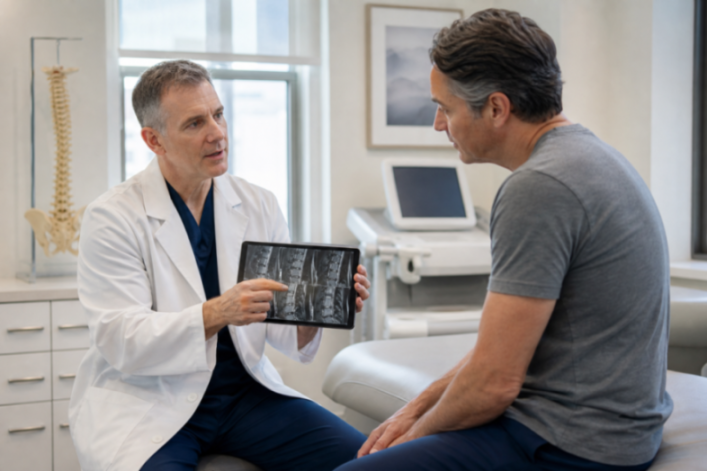
Every effective treatment plan starts with a careful, individualized evaluation. At your first visit our physicians take a detailed history, perform a focused physical exam, and review prior imaging and records. We ask about the onset, quality and pattern of pain, factors that worsen or improve symptoms, and how pain affects work, sleep and daily activities—information that helps us match treatments to goals. When needed, we perform diagnostic nerve testing such as nerve conduction studies (NCS) and electromyography (EMG) to clarify nerve injury or entrapment; learn more about this testing at Nerve Conduction Testing. NCS/EMG can distinguish between muscle disease and nerve compression and help localize the level of nerve involvement.
Imaging and diagnostic clarity
We routinely correlate MRI, CT or X‑ray findings with clinical symptoms before recommending treatment. Imaging-guided procedures (using fluoroscopy, ultrasound or CT) allow us to treat with precision while minimizing tissue disruption. For example, fluoroscopically guided epidural steroid injections place medication next to an inflamed nerve root, while ultrasound can be helpful for many peripheral joint and soft tissue injections.
Non‑surgical and minimally invasive treatment options
MK Spine & Joint Rehab focuses on therapies that reduce pain and restore function while avoiding, when appropriate, major surgery. Our multidisciplinary toolbox includes medication management, rehabilitation therapies and image-guided interventions. Choosing among these relies on the cause and severity of pain, prior treatments, your overall health and the functional goals you set with your clinician.
Medication management
Medication can play an important role in controlling pain while other therapies take effect. Our physicians provide tailored medication plans that emphasize safety and functionality. We use multimodal, opioid‑sparing strategies when possible, combining oral agents, topical therapies and medications targeted to nerve pain (neuropathic agents) or inflammation. Plans include monitoring for side effects and interactions and coordination with your primary care provider or specialists; details on our approach are available at Medication Management.
Physical and occupational rehabilitation
Rehabilitation is a central component of durable pain improvement. Customized physical therapy programs help patients regain mobility, strength and movement patterns that reduce stress on painful structures. Occupational therapy can address workplace ergonomics, adaptive strategies and graded return-to-work plans—especially relevant for Long Island residents in physically demanding fields. MK Spine & Joint Rehab coordinates medical and rehabilitative care to accelerate recovery and improve long‑term outcomes.
Image‑guided, minimally invasive procedures
When targeted intervention is appropriate, our physicians use image guidance to perform outpatient procedures with precision. These include epidural and facet injections, radiofrequency ablation (RFA), percutaneous disc decompression, spinal cord stimulation trials and implantation, intrathecal pain pumps, and joint injections. Learn about our full suite of options at Minimally Invasive Procedures.
For certain herniated discs that are refractory to conservative care, percutaneous disc decompression can reduce pressure on nerve roots and relieve radicular pain; see our patient resource How Percutaneous Disc Decompression Can Relieve Chronic Back Pain for more information. Candidates are generally those with contained herniations and concordant symptoms where nonoperative care has not provided adequate relief.
Specialized interventional techniques we provide
- Spinal epidurals and facet injections for targeted pain relief; epidurals often reduce radicular pain for weeks to months while rehabilitation proceeds.
- Radiofrequency ablation for longer-lasting relief of facet-mediated back and neck pain; eligibility usually follows diagnostic medial branch blocks that predict benefit—details at Radiofrequency Ablations.
- Spinal cord stimulation (trial and implant) for neuropathic or failed-back-surgery pain patterns. Trials are temporary, typically lasting several days to a week, allowing patients to assess pain reduction and functional improvement before committing to a permanent implant.
- Intrathecal pain pumps for carefully selected patients with chronic refractory pain; pumps deliver medication directly to the spinal fluid, often at lower systemic doses, and require ongoing refills and follow-up—more at Pain Pumps.
- Botox injections for chronic migraine management and joint injections for osteoarthritis or inflammatory joint pain. Image guidance improves accuracy and outcomes for many of these procedures.
Why choose MK Spine & Joint Rehab in Hauppauge
Our practice blends board-certified physicians, diagnostic expertise and coordinated rehabilitation in a patient-centered outpatient setting. We emphasize shared decision-making so each plan fits your goals, work demands and lifestyle. If you prefer a local site, our Hauppauge office offers convenient access to interventional services for Suffolk County residents; see Hauppauge Office for location and hours. Patients who live or work on Long Island benefit from shorter travel times for follow-up visits and procedure appointments, which can improve adherence and recovery.
Local context and common causes of pain we see
On Long Island, we commonly treat people with degenerative spine conditions, sports and work-related injuries, and pain after motor vehicle crashes. Typical occupational contributors include repetitive lifting, prolonged driving or standing, and tasks with awkward postures—factors we consider when designing return-to-work and rehabilitation plans.
Who can benefit from our care
Patients who commonly seek our services include those with:
- Chronic low back, neck or limb pain
- Radicular pain or sciatica after disc injury
- Joint pain from osteoarthritis or overuse
- Nerve injuries from workplace or sports incidents
- Pain following a motor vehicle accident
- Patients seeking to avoid or postpone major spinal surgery
Preparing for your first appointment
To maximize the initial visit, bring recent imaging (MRI, CT, X‑rays), a list of current medications, records from prior specialists, and documentation related to work or auto injuries if applicable. Consider keeping a short pain diary for a week before your visit noting pain intensity, activities that change pain, sleep disturbance and pain-related limitations. Also bring any relevant insurance or claim numbers and a list of specific goals (for example, “return to gardening” or “reduce pain enough to work full shifts”). Expect a comprehensive evaluation with time for questions and discussion of conservative and interventional options.
Realistic expectations and outcome focus
Our goal is to reduce pain, improve function and help you return to the activities you value. While many patients experience significant relief with combined medical and rehabilitative treatments, individual responses vary. We will discuss probable outcomes, risks and timelines so you can make informed decisions. For instance, temporary injections may provide short- to intermediate-term relief that enables rehabilitation, RFA can offer months of benefit for facet pain, and spinal cord stimulation may provide durable pain reduction for selected neuropathic conditions after a successful trial.
How we help you choose the right option
Decisions are individualized. Factors we weigh include the severity and pattern of pain, imaging-test correlation, results of diagnostic blocks or nerve testing, prior response to treatments, medical comorbidities and your personal goals (e.g., return to work, avoid surgery, reduce medications). We discuss timelines and what improvement looks like for each option so you can choose a plan that fits your life.
Insurance, referrals and coordination of care
MK Spine & Joint Rehab accepts many major insurers and works with referring providers to coordinate care. If you were referred after a workplace or motor vehicle injury, bring relevant claim information. Our team can help with prior authorizations and scheduling required diagnostics and treatments. We also communicate with surgeons, physiatrists, neurologists and primary care physicians as needed to ensure seamless care.
Schedule an evaluation
If you are ready to take the next step, book an appointment at our Hauppauge office or contact our Garden City location. You can also schedule online or call to arrange a consultation at the Garden City or Hauppauge office. Our team will help you navigate diagnostics, treatment options and a personalized plan focused on reducing pain and restoring function.
Learn more
For additional information on our philosophy and services, visit our Pain Management overview page or call to speak with a member of our staff. We encourage patients to review educational resources and bring questions to their visit so together we can choose the best, evidence-informed approach for your situation.
Frequently Asked Questions
What types of pain do your Hauppauge doctors treat?
Our board-certified physicians treat chronic and injury-related spine, nerve and joint pain, including low back and neck pain, radiculopathy (sciatica), osteoarthritis, neuropathic pain and post-injury or post‑surgical pain syndromes.
Do I need a referral to see a pain management doctor at MK Spine & Joint Rehab?
Many patients can self-refer; however, some insurance plans require a primary care referral. If you have a workers’ compensation or motor vehicle injury claim, bring documentation. Our staff can help confirm requirements and assist with scheduling.
What should I bring to my first appointment?
Bring recent imaging (MRI, CT or X-rays), a list of medications, records from prior providers, and any paperwork related to work or auto injuries. Having this information helps our team make an accurate diagnosis and treatment plan. A short pain diary and clear functional goals are also useful.
Are procedures performed on an outpatient basis?
Yes. Many image-guided interventions, such as epidural or facet injections, RFA, percutaneous disc decompression and trials for spinal cord stimulation, are performed on an outpatient basis with local anesthesia and sedation as appropriate.
How do you decide between medication, therapy and procedures?
Decisions are individualized based on your history, physical exam, diagnostic testing and treatment goals. We typically recommend conservative measures first—rehabilitation and medication management—and consider targeted procedures when indicated to reduce pain and improve function.
What is radiofrequency ablation and is it right for me?
Radiofrequency ablation (RFA) uses heat to interrupt pain signals from small nerves that supply facet joints. It can provide months of relief for patients with facet-mediated pain. Eligibility is determined after diagnostic injections and clinical evaluation. Learn more at our Radiofrequency Ablations page.
How do I schedule an appointment at the Hauppauge office?
You can schedule online via our Hauppauge office page or call our office directly to book a consultation. Our team will guide you through intake, required records and next steps for diagnostics and treatment.
Do I need a referral to see a pain management doctor at MK Spine & Joint Rehab?
Many patients can self-refer; however, some insurance plans require a primary care referral. If you have a workers' compensation or motor vehicle injury claim, bring documentation. Our staff can help confirm requirements and assist with scheduling.