
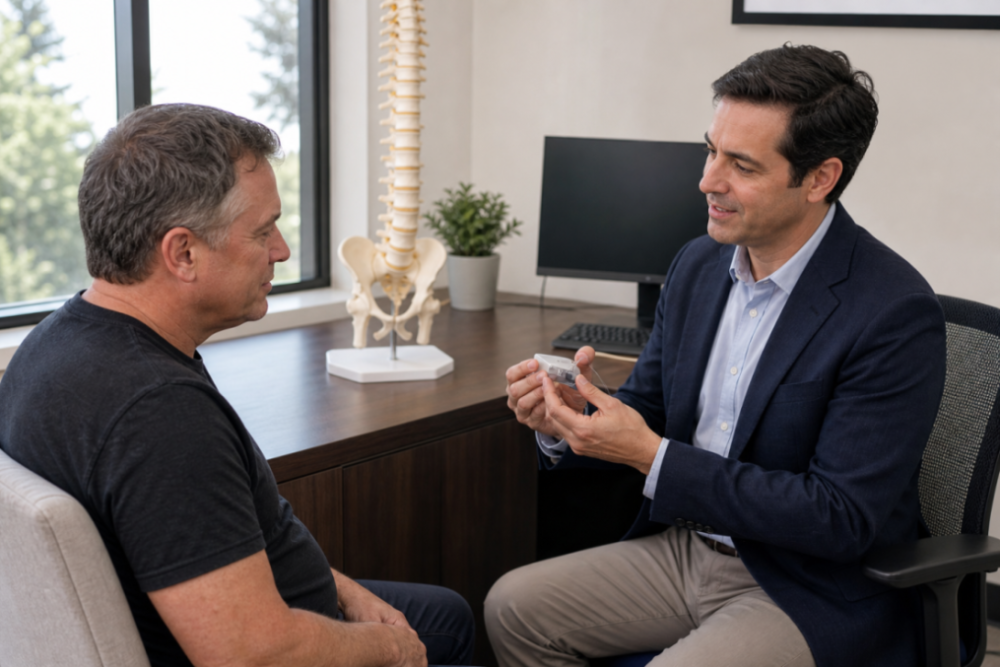
If chronic spine or nerve pain hasn’t improved enough with other treatments, an intrathecal pain pump may offer relief with smaller doses of medication than you’d take by mouth. Here’s how an implanted pump works, who may benefit, and what to expect from an evaluation and follow-up at MK Spine & Joint Rehab in Garden City.
What is an intrathecal pain pump?
An intrathecal pain pump is a small implanted device that delivers medication directly into the cerebrospinal fluid around your spinal cord. Because the medication reaches pain receptors more directly, it can often relieve pain at much lower doses than oral medication.
How does intrathecal drug delivery work?
The system has two parts: a thin tube called a catheter, which sits in the fluid-filled space around the spinal cord, and a pump with a medication reservoir, which usually sits under the skin of the lower abdomen. Your clinician programs the pump to deliver a steady dose and, when appropriate, extra doses for pain that breaks through. Depending on the pump settings, those extra doses can be triggered by you or your clinician.
Specialists choose the medication and dose based on the type of pain you have and how you respond. Options include low-dose opioids such as morphine or hydromorphone, local anesthetics, and, when appropriate, medications such as clonidine or ziconotide. Not every medication is FDA-approved for use with every pump. For example, the FDA’s overview of the Prometra pump identifies which medications are approved for that device. Many patients report better pain control with fewer side effects such as drowsiness or constipation, though side effects are still possible.
Who may be a candidate in Garden City?
We consider an intrathecal pump when less invasive treatments haven’t helped enough or when side effects make it hard to take an effective dose of oral medication. A pump may be an option for adults with:
- Persistent spine pain, pain that travels along a nerve, or pain that continues after surgery despite conservative care.
- Severe muscle spasticity that responds to baclofen delivered through a pump.
- Side effects that prevent an increase in oral pain medication.
A pump may make more sense when pain is widespread or when medication that circulates through the body causes unacceptable side effects. For pain that follows a specific nerve, spinal cord stimulation or another targeted procedure may be a better fit. A good response to a temporary intrathecal or epidural injection can help inform the decision, but it doesn’t guarantee the same results from an implant.
At our Garden City office, we review your imaging and treatment history, consider whether more testing would help, and talk through your medication and rehabilitation needs before recommending a pump.
Benefits and important risks
A pump may give you better pain control at a lower medication dose and reduce opioid-related side effects such as nausea, constipation, or drowsiness. In many cases, your clinician can adjust how much medication the pump delivers without another surgery.
There are risks to weigh, including infection, medication side effects, pump malfunction, and problems with the catheter, such as shifting out of place. You’ll also need regular refills and device checks. We’ll explain those responsibilities and talk with you about what you’d want to gain, whether that’s sleeping better, walking farther, or getting through daily tasks with less pain.
How we evaluate you at MK Spine & Joint Rehab
We start by asking where your pain is, what you’ve already tried, and what it’s keeping you from doing. We’ll examine you and review your previous tests and imaging, ordering more only if needed. We also look at what your current medications are doing for you and where they’re falling short. That review is part of our approach to medication management alongside other pain treatments.
If an implant is worth considering, we’ll talk through the alternatives, what you can reasonably expect, and what follow-up would involve. Depending on your condition, we may recommend a nerve block to help clarify the source of your pain or a temporary pump trial to see how you respond to medication. A trial may involve a single intrathecal injection or an epidural injection in the upper lumbar spine. Roughly 50% pain reduction is a commonly used benchmark, but we also look for measurable changes in how well you sleep, walk, or manage everyday tasks. Our rehabilitation team can help plan for recovery if you move ahead with the implant.
What to expect during implantation and follow-up
Implantation is usually an outpatient procedure performed under image guidance. After placement, your clinician programs the pump. Before you go home, we’ll explain how to care for the incision, which activities to limit, and when to call us urgently. You’ll return to the clinic for refills and regular checks of the pump and its settings.
During a refill, a clinician uses a needle and sterile technique to access the reservoir through the skin. How often you’ll need to come in depends on the medication and pump settings. Carry your device ID when traveling or seeing another healthcare provider, and bring your device ID to any MRI appointment so the imaging team can identify your pump. If your pump is labeled MR Conditional, you can have an MRI only under the conditions specified for that model. Your care team will check your pump model and the scan requirements before scheduling an MRI.
As your activity restrictions ease, our postprocedure physical therapy team in Garden City can help you return to daily activities at a safe pace.
Alternatives and complementary options
A pump is one option, not the only next step. Depending on what’s causing your pain, we may discuss an image-guided injection, spinal cord stimulation, or changes to your medication and rehabilitation plan. If you’re weighing intrathecal drug delivery against radiofrequency ablation, the key difference is that a pump delivers medication near the spinal cord, while ablation targets specific nerves that carry pain signals.
We’ll help you compare the options based on your diagnosis, what you’ve already tried, and what you want to get back to doing. If a pump is still on the table, our pain pump treatment overview explains how it fits into your care.
Questions you should ask during evaluation
These questions can help you decide whether a pump fits your needs:
- How much pain relief and improvement in daily function can I reasonably expect?
- What are the short- and long-term risks of an implanted pump?
- How might changes to my medication affect my daily life?
- How often will I need follow-up visits, refills, or maintenance?
- Would a temporary trial help me decide whether to move ahead?
Getting care on Long Island
MK Spine & Joint Rehab (Marvin Kalter Spine & Joint, P.C.) serves Nassau and Suffolk Counties from our Garden City and Hauppauge offices. Our team offers image-guided procedures, careful medication management, diagnostic nerve testing, and coordinated rehabilitation to help you improve function with the least invasive care that makes sense for you.
If you’re considering an implanted pump, a consultation at our Garden City location gives us a chance to review what you’ve tried and explain which options are still open to you. Before your visit, our staff can help with directions, parking, and accessibility.
Next steps and scheduling
You can book online or call our Garden City office to schedule a consultation. If a pump isn’t the right next step, we’ll talk through other minimally invasive options and how rehabilitation might help you manage pain and get back to more of your daily routine.
Frequently Asked Questions
How long does a pain pump last?
Pumps are designed for long-term use, but how long one lasts depends on the model and its battery life. Some pumps need replacing after several years. We’ll discuss the expected lifespan and maintenance needs of your device during the evaluation.
Will I still need oral pain medicine after implantation?
Many patients can reduce or stop oral opioids after successful intrathecal therapy, but medication needs vary. We’ll follow up closely and make changes based on your pain control and any side effects.
Is the implantation procedure painful and what is recovery like?
Implantation is usually done under anesthesia as an outpatient procedure and is generally well tolerated. During recovery, you’ll have temporary activity restrictions, instructions for incision care, and follow-up visits for programming and refills.
What complications should I be aware of?
Possible complications include infection, catheter problems, pump malfunction, and medication side effects. We’ll explain what to watch for and when to contact your care team.
How often will I need to get the pump refilled?
Refills are typically spaced anywhere from several weeks to several months apart. Your clinician will set the schedule based on the medication and how much the pump delivers.
Can I have a trial to predict how well the pump will work for me?
Yes. A temporary trial or another diagnostic procedure can help estimate how much relief you might get before you commit to an implant. We’ll recommend an approach based on your condition and treatment history.
How do you choose between a pump and other options like spinal cord stimulation?
We look at what’s causing your pain, what’s helped before, and what you want to be able to do. A pump may be a better fit for widespread pain or pain that responds to medication. Spinal cord stimulation may make more sense for certain types of nerve pain, including pain that travels along a specific nerve.
Trackbacks/Pingbacks