When chronic neck or back pain affects daily life, choosing a local, experienced pain doctor can make care simpler and more effective. If you are searching for a pain doctor Hauppauge Suffolk County, MK Spine & Joint Rehab (Marvin Kalter Spine & Joint, P.C.) offers a multidisciplinary, outpatient approach that combines careful diagnosis, imaging-guided procedures, medication management and rehabilitation to improve function and reduce pain.
Individualized evaluation: the first step
Every treatment plan at MK Spine & Joint Rehab begins with a detailed medical history, physical examination and targeted diagnostics. For patients with suspected nerve or spinal pathology, the practice provides diagnostic nerve testing such as nerve conduction studies and EMG to clarify the source of symptoms. Imaging studies (X‑ray, MRI or CT) are reviewed in context of symptoms to guide next steps.
For example, a patient presenting with sharp, shooting pain down the leg and objective weakness on exam may undergo MRI to identify a lumbar disc herniation and an EMG to confirm radiculopathy. If imaging and electrodiagnostic testing localize a single nerve root, options may include a targeted transforaminal epidural steroid injection or a referral for microdiscectomy if conservative care fails and neurologic deficits progress. These stepwise decisions help match treatment to the underlying cause rather than treating symptoms alone.
How minimally invasive procedures fit into a treatment plan
Minimally invasive, image-guided procedures are intended to diagnose and treat pain while minimizing tissue disruption and downtime. At MK Spine & Joint Rehab, these procedures are used as part of a combined plan that typically includes medical management and supervised physical or occupational therapy.
Common outpatient procedures offered
- Epidural steroid and facet injections to reduce inflammation and localize pain sources (Spinal Epidurals and Facet Injections).
- Radiofrequency ablation (RFA) for sustained relief of facet-mediated back or neck pain (Radiofrequency Ablation for Neck and Back Pain).
- Percutaneous disc decompression to relieve symptoms from a contained herniated disc (Percutaneous Disc Decompression).
- Spinal cord stimulation trials and implantation for chronic, refractory neuropathic or radicular pain (Spinal Cord Stimulator Trials and Implantation).
- Implanted drug delivery systems (pain pumps) for appropriately selected patients.
- Joint injections and Botox for chronic migraine where clinically indicated.
To illustrate how these fit together: a patient with axial neck pain caused by facet arthropathy may first receive diagnostic medial branch blocks. If short-term relief confirms the facet as the pain generator, radiofrequency ablation can provide longer-lasting benefit. Conversely, radicular pain with nerve-root inflammation may respond best to a selectively targeted epidural injection while pursuing rehabilitation.
Why image guidance matters
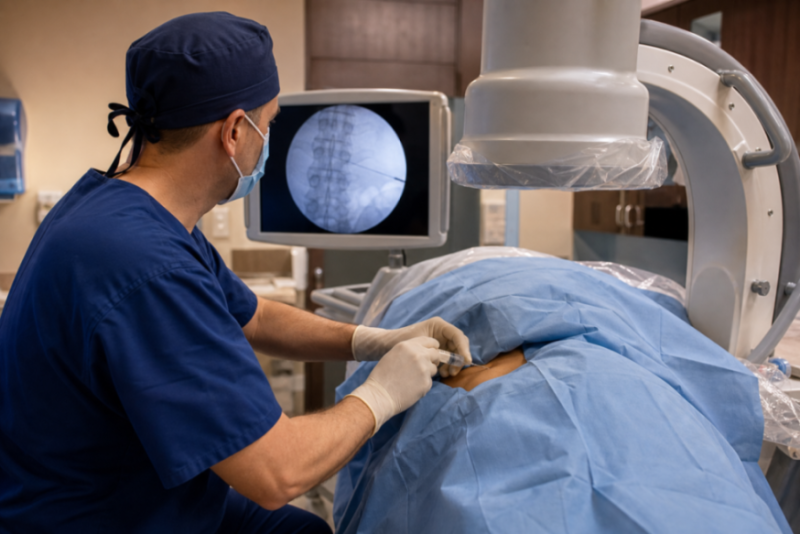
Image guidance — fluoroscopy or ultrasound — helps the interventional pain physician place needles and devices precisely. That precision improves diagnostic accuracy, increases the likelihood of therapeutic benefit and reduces the risk of complications. MK Spine & Joint Rehab emphasizes imaging-guided techniques during procedures performed in their outpatient setting.
Clinical decision-making: when a procedure is appropriate
Procedures are considered after conservative measures (education, activity modification, medications and directed rehabilitation) and when diagnostic workup indicates a specific target. Examples include a steroid injection for suspected nerve-root inflammation, RFA for facet-joint pain confirmed by diagnostic blocks, or a spinal cord stimulator trial for persistent neuropathic pain that has not responded to less invasive interventions. The practice reviews surgical options with patients and coordinates referrals when operative care is indicated.
Decision guidance: clinicians typically weigh symptom severity, duration, objective findings (imaging/EMG), response to prior nonsurgical treatment, comorbidities and patient goals. Contraindications such as uncontrolled infection, certain bleeding disorders, or unstable medical conditions are reviewed before proceeding. When uncertainty exists, targeted diagnostic injections can act both diagnostically and therapeutically to inform next steps.
What patients can expect before, during and after a procedure
Pre-procedure evaluation includes review of medical history, medications and imaging. Many minimally invasive interventions are performed under local anesthesia with conscious sedation when appropriate, and most patients return home the same day. Aftercare focuses on symptom monitoring, staged return to activities and a coordinated rehabilitation plan to restore function. The team provides clear post-procedure instructions and schedules follow-up to assess response and next steps.
Practical examples: patients are often advised to stop blood-thinning medications several days beforehand when safe (in coordination with the prescribing physician), arrange a caregiver for the day of the procedure if sedation is used, and expect mild soreness at the injection site for 24–72 hours. Follow-up visits typically occur within 1–6 weeks depending on the intervention to document pain relief and functional progress.
Integrating rehabilitation and medication management
Procedures are most effective when paired with rehabilitation and an individualized medication strategy. MK Spine & Joint Rehab offers physical therapy programs and medication management to address pain control, strength, flexibility and return-to-work goals. Their multidisciplinary approach helps patients transition from symptom relief to durable functional improvement (Physical Therapy).
Rehabilitation examples include graded strengthening for core and paraspinal muscles after lumbar interventions, posture and ergonomic training for neck pain, and work conditioning programs for patients returning to physically demanding jobs. Medication strategies focus on minimizing opioid exposure when possible, using adjuvant agents for neuropathic pain, and tailoring anti-inflammatory or muscle-relaxant regimens to permit active participation in therapy.
Safety, risks and realistic expectations
All procedures carry potential risks. Interventional pain specialists discuss expected benefits, possible complications and alternative treatments so patients can make informed decisions. While many patients experience meaningful pain reduction and improved activity tolerance, no legitimate provider guarantees pain elimination. The goal is measurable improvement in pain and function, enabling better participation in rehabilitation and daily life.
When to consider advanced options like spinal cord stimulation
For chronic neuropathic or radicular pain that does not respond to injections, medications and therapy, a spinal cord stimulator trial may be considered. MK Spine & Joint Rehab evaluates candidates carefully and offers trial programs to test efficacy before permanent implantation (Spinal Cord Stimulation: Evaluation and Trial Program in Hauppauge and Spinal Cord Stimulators).
Trial stimulation typically lasts several days to a week, allowing patients to compare baseline pain and activity levels with stimulation on. Success is measured by meaningful functional improvement and pain reduction, not only numeric pain scores—examples include improved sleep, increased walking tolerance, or return to part-time work.
Choosing a pain doctor in Long Island
When selecting a provider, look for clinicians who combine accurate diagnosis, a range of minimally invasive options, image-guided technique and coordinated rehabilitation plans. Consider additional factors such as board certification in pain medicine or physiatry, procedure volume and experience, published patient outcomes or testimonials, insurance participation and ease of scheduling. MK Spine & Joint Rehab’s dual offices in Garden City and Hauppauge allow local access to interventional care and ongoing follow-up in the community—helpful for patients who prefer shorter drives for repeat visits or post-procedure checks.
How to make an appointment
If you live in Suffolk or Nassau County and want an evaluation, you can visit the Hauppauge office page for location details or contact us to book an appointment online or by phone. During your consultation the team will review your history, imaging and goals, and discuss whether a minimally invasive, image-guided procedure may be appropriate as part of your individualized plan.
Further patient resources
For background on non-surgical options for common spinal conditions, MK Spine & Joint Rehab provides condition‑specific information, procedural overviews and patient resources on their website, including a focused overview of minimally invasive spine procedures in Hauppauge (Overview of Minimally Invasive Spine Procedures at Pain Clinic in Hauppauge).
MK Spine & Joint Rehab’s clinical approach emphasizes clear diagnosis, safe image-guided technique, outpatient convenience and coordinated rehabilitation to help patients regain function. To schedule a consultation at the Garden City or Hauppauge office, book an appointment online or call the clinic to speak with a team member.
Frequently Asked Questions
What are minimally invasive spine procedures?
Minimally invasive spine procedures are targeted, image-guided interventions—such as epidural or facet injections, radiofrequency ablation, percutaneous disc decompression and spinal cord stimulation trials—performed through small skin punctures to diagnose or treat spine-related pain with less tissue disruption than open surgery.
How does MK Spine & Joint Rehab decide which procedure is right for me?
The team uses a stepwise approach: thorough history and exam, diagnostic testing (including nerve conduction studies/EMG), review of imaging, and conservative therapies. If a procedure is indicated, they select the option that best matches your diagnosis, symptoms and functional goals and explain risks and alternatives.
Are these procedures performed as outpatient care?
Yes. Most minimally invasive spine procedures at MK Spine & Joint Rehab are performed in an outpatient setting under image guidance, with same-day discharge and clear post-procedure instructions to support recovery and rehabilitation.
What is the role of image guidance during procedures?
Image guidance—typically fluoroscopy or ultrasound—helps clinicians place needles and devices precisely at the target, improving diagnostic accuracy and therapeutic effect while minimizing risk to surrounding tissues.
Will I need physical therapy after a procedure?
Often. Interventions that reduce pain are most effective when combined with a tailored rehabilitation plan to restore strength, mobility and function. MK Spine & Joint Rehab coordinates physical therapy as part of comprehensive care.
How long before I know if a procedure worked?
Response time varies by procedure: some injections provide near-immediate short-term relief to help localize the pain source, while benefits from radiofrequency ablation or spinal cord stimulation trials may take days to weeks. Your provider will schedule follow-up to assess outcomes and next steps.
Do I need to stop blood thinners before a procedure?
Medication management is individualized. Many interventional procedures require temporary modification of anticoagulant or antiplatelet therapy to reduce bleeding risk. Decisions are made in coordination with the prescribing physician and based on the specific drug, indication and procedural risk.
How can I schedule a consultation in Hauppauge?
You can book an appointment online through the practice website or call to schedule a consultation at the Hauppauge or Garden City office. Visit the Hauppauge office page or the contact page for details and directions.
How does MK Spine & Joint Rehab decide which procedure is right for me?
The team uses a stepwise approach: thorough history and exam, diagnostic testing (including nerve conduction studies/EMG), review of imaging, and conservative therapies. If a procedure is indicated, they select the option that best matches your diagnosis, symptoms and functional goals and explain risks and alternatives.