
Understanding Minimally Invasive Spine Care Near You
If you live in Garden City or elsewhere on Long Island and are searching for compassionate, evidence-based pain management options in Garden City, NY, minimally invasive spine procedures can be an effective part of a personalized treatment plan. At MK Spine & Joint Rehab (Marvin Kalter Spine & Joint, P.C.), our multidisciplinary approach combines diagnostic testing, medication review, image-guided interventions, and rehabilitation to reduce pain, improve function, and help patients return to daily life.
What “Minimally Invasive” Means for Spine Pain
Minimally invasive procedures are typically outpatient, use small incisions or percutaneous access, and rely on imaging (fluoroscopy or CT) to target the source of pain precisely. Because these procedures are less disruptive to tissues than open surgery, they often mean shorter recovery times and lower complication rates. We may recommend them when conservative measures—such as activity modification, targeted medication, and physical therapy—haven’t provided adequate relief.
Common Image-Guided Procedures We Offer
- Epidural and Facet Injections: Steroid and anesthetic injections can reduce inflammation around nerve roots or painful facet joints and provide diagnostic information about the source of pain. Learn more about our spinal epidurals and facet injections here.
- Radiofrequency Ablation (RFA): RFA can provide longer-lasting relief for facet-mediated back or neck pain by interrupting pain signals from small sensory nerves. Details are available on our Radiofrequency Ablations page.
- Percutaneous Disc Decompression: For select patients with contained disc herniations, a percutaneous approach can reduce pressure on nerves without open surgery. See how percutaneous disc decompression may help certain types of chronic back pain.
- Spinal Cord Stimulation and Pain Pumps: For persistent neuropathic pain not responding to other interventions, spinal cord stimulators and intrathecal pain pumps offer tailored neuromodulation or drug delivery therapies. Learn more about our spinal cord stimulator and pain pump options on the Spinal Cord Stimulators and Pain Pumps pages.
- Joint Injections and Botox: Targeted joint injections can relieve arthritic pain, while Botox may be offered for chronic migraine-related neck pain as part of a comprehensive plan. See our Joint Injections and Botox for Migraines treatments.
How We Evaluate Candidates for Minimally Invasive Procedures
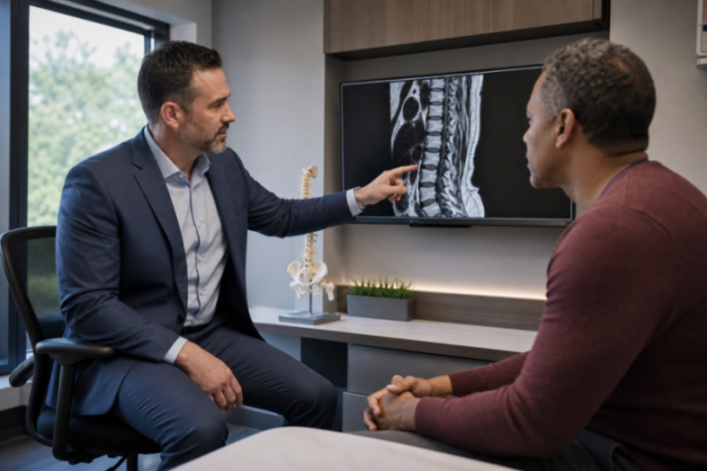
At MK Spine & Joint Rehab we emphasize individualized evaluation. A thorough history and physical exam—often supplemented by diagnostic nerve testing such as nerve conduction studies/EMG—helps identify whether pain arises from nerve compression, facet joints, discs, or soft tissues. Advanced imaging (MRI/CT) and diagnostic injections may be used to confirm the pain generator before recommending an intervention.
Multidisciplinary, Non‑Surgical Focus
Interventional procedures are one component of care. Our team integrates medication optimization (see Medication Management), activity modification, and rehabilitation—often coordinated with physical and occupational therapy—to restore strength, flexibility, and function. This collaborative model helps patients avoid or postpone surgery when appropriate.
What to Expect During and After a Procedure
Most minimally invasive spine procedures are performed on an outpatient basis using conscious sedation or local anesthesia with imaging guidance for accurate placement. Typical steps include:
- Pre-procedure evaluation and medication review.
- Image-guided placement of a needle or electrode to the target area.
- Administration of medication, thermal lesioning (RFA), percutaneous decompression, or device implantation as indicated.
- Short recovery observation and discharge instructions with activity and medication guidance.
Recovery varies by procedure: injections often allow same-day activity resumption with short-term soreness; RFA can cause mild soreness for several days with pain relief developing over 2–6 weeks; device trials and implants (spinal cord stimulators, pumps) require staged evaluation and careful follow-up. We provide specific, written post-procedure instructions and coordinate rehabilitation to support functional recovery.
Risks, Benefits, and Setting Realistic Expectations
Minimally invasive techniques reduce tissue trauma and recovery time, but they are not risk-free. Potential complications—rare but possible—involve bleeding, infection, transient nerve irritation, or inadequate relief. Importantly, outcomes are most favorable when procedures are targeted to the confirmed pain source and combined with rehabilitation. Our clinicians discuss risks, benefits, and alternative options—including surgical referral when appropriate—so you can make an informed decision.
Why Choose MK Spine & Joint Rehab in Garden City
Our practice on Long Island blends interventional expertise with rehabilitation and diagnostic services to deliver coordinated, patient-centered care. We prioritize:
- Individualized treatment planning based on testing and imaging.
- Image-guided, outpatient procedures performed with safety and precision.
- Close coordination between providers, therapists, and patients to restore function.
- Clear communication about realistic goals and expected outcomes.
To learn more about our team and approach, visit our About page. If you prefer an office near you, we have locations in Garden City and Hauppauge; schedule at the Garden City office or contact us to book a consultation.
Next Steps: Evaluation and Scheduling
If chronic or injury-related spine, nerve, or joint pain is affecting your quality of life, start with an evaluation to define the source and explore appropriate interventions. You can book an appointment online for our Garden City office or call to schedule. During your visit, we will review history, perform a focused examination, review imaging and nerve testing if needed, and discuss individualized non-surgical and minimally invasive options.
Resources and Further Reading
For patient-focused information on spine conditions and interventional options, trustworthy resources include the American Academy of Pain Medicine and the North American Spine Society. Our team stays current with best practices to offer safe, evidence-informed care; you can also read more about interventional spine techniques on our site at Interventional Spine Techniques: A Guide to Minimally Invasive Pain Relief and explore the full list of Minimally Invasive Procedures we provide.
Call to Action
If you’re in Garden City or elsewhere on Long Island and want a thoughtful, multidisciplinary approach to reduce pain and restore function, book an appointment online or call to schedule a consultation at our Garden City or Hauppauge office. Our team will work with you to develop a personalized plan emphasizing safe, image-guided interventions and coordinated rehabilitation.
Frequently Asked Questions
What types of spine pain are good candidates for minimally invasive procedures?
Patients with radicular pain from nerve compression, facet-mediated back or neck pain, contained disc herniations, or persistent neuropathic pain that has not responded to conservative care may be candidates. The right procedure depends on a targeted evaluation including history, exam, imaging, and sometimes diagnostic injections or nerve testing.
Are minimally invasive spine procedures performed as outpatient treatments?
Yes. Most image-guided spine procedures at our practice are performed on an outpatient basis with local anesthesia or conscious sedation. Patients are monitored briefly post-procedure and typically go home the same day with written aftercare instructions.
How long does it take to feel relief after a radiofrequency ablation (RFA)?
Relief after RFA often develops over several weeks as the treated nerves stop transmitting pain signals. Some patients notice early improvement within days, while full benefit is frequently observed by 4 to 6 weeks. Individual experiences vary.
Will an injection or procedure cure my back pain permanently?
Procedures can significantly reduce pain and improve function, but they do not guarantee a permanent cure. Results depend on the underlying condition, the accuracy of targeting the pain source, and follow-up rehabilitation. We focus on realistic goals and combined treatments to maximize durable benefit.
What risks should I expect with image-guided spine interventions?
Risks are generally low but can include temporary increased pain, bleeding, infection, or nerve irritation. Serious complications are uncommon. Your clinician will review procedure-specific risks and precautions during informed consent.
How do you coordinate care between procedures and rehabilitation?
We develop individualized plans that combine interventions with medication adjustments, physical or occupational therapy, and activity modification. Our team communicates closely so therapy begins or progresses at the appropriate time after procedures to restore strength and function.
How can I schedule a consultation at the Garden City office?
You can book an appointment online for the Garden City office or call to schedule. During the consultation we will review your history, exam findings, and imaging to recommend tailored, evidence-informed options.