
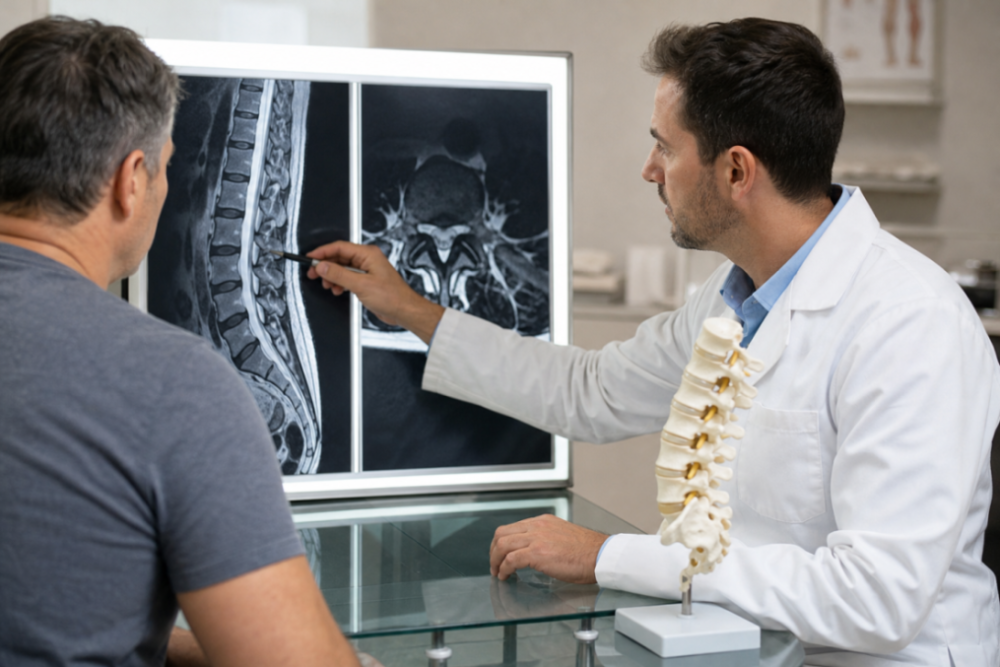
Percutaneous discectomy is a minimally invasive option for selected patients with a contained herniated disc who have not responded to conservative care. This outpatient procedure can reduce disc pressure and nerve irritation, but careful evaluation is essential to determine if it is the best choice for your situation.
What is percutaneous discectomy (disc decompression)?
Percutaneous discectomy—also described as percutaneous disc decompression or nucleotomy—is a minimally invasive procedure that removes a small portion of disc material to reduce pressure on nearby nerves. Unlike open surgical discectomy, it uses image guidance and a small access needle or cannula, and is typically performed as an outpatient with local anesthesia and sedation.
How does it relieve pain from a herniated disc?
A herniated disc can press on spinal nerves and cause radiating pain, numbness, or weakness. Removing a small volume of nucleus material lowers intradiscal pressure and can shrink the herniation enough to reduce nerve irritation.
For appropriately selected patients, that mechanical decompression can provide meaningful symptom relief without open surgery. When inflammation is a major contributor, anti-inflammatory treatments (for example, epidural steroid injections) are commonly used alongside decompression.
Who is a good candidate?
Not every herniated disc is appropriate for a percutaneous approach. Ideal candidates generally share these features:
- Symptoms from a single-level, contained (non-sequestered) herniation confirmed on MRI or CT.
- Predominant radicular pain or nerve-related symptoms (e.g., sciatica) that correlate with imaging findings.
- Failure of a thorough course of conservative care—physical therapy, medication management, and image‑guided injections—over several weeks to months (commonly 6–12 weeks, depending on severity and clinical course).
- No spinal instability, severe central canal stenosis, progressive neurologic deficit, or infection.
Common contraindications include migrated or sequestered fragments (difficult to reach percutaneously) and progressive weakness or bowel/bladder dysfunction, which usually prompt urgent surgical referral. Assessment by a board‑certified pain medicine specialist is essential.
At MK Spine & Joint Rehab we combine diagnostic nerve testing, medication management, and rehabilitation to define candidacy precisely. For a general overview of when percutaneous disc decompression may be appropriate, see our page on Is percutaneous disc decompression right for neck/back pain?.
Evaluation: what the clinic visit involves
A careful evaluation includes clinical history, a focused neurologic exam, and review of prior imaging. We may order or review MRI or CT to confirm disc anatomy and ensure the herniation is contained and accessible percutaneously.
MRI sequences most useful include sagittal and axial T2-weighted images to visualize disc material and nerve root compression. If you have imaging from another facility, bring the CD or a digital copy so the treating physician can review full sequences rather than only reports.
Diagnostic nerve studies (nerve conduction studies/EMG) help when symptoms or exam findings are ambiguous or when multiple levels are suspected. We also review medical history for bleeding risks and medications: anticoagulants or antiplatelet drugs often need temporary adjustment before the procedure under physician guidance.
MK Spine & Joint Rehab emphasizes individualized plans that commonly combine minimally invasive procedures with rehabilitation and medication management; see our Medication Management and Multimodal Pain Care in Garden City page for more about coordinated care.
What happens during the procedure?
The procedure is typically performed under fluoroscopic (x‑ray) guidance in an outpatient setting. A needle or small probe is advanced into the disc and a small amount of nucleus is removed or ablated depending on the technique used.
Common percutaneous techniques include mechanical discectomy (small cutter or suction), nucleoplasty/coblation (radiofrequency plasma to remove nucleus tissue), and in some centers, laser-assisted approaches. The goal is mechanical decompression with minimal disruption to surrounding tissues, and most patients go home the same day with instructions for activity restrictions and a rehabilitation plan.
You should arrange a responsible adult to drive you home and expect a short postprocedure recovery period in the clinic.
Typical procedural steps (overview):
- Preprocedure review and local anesthesia with conscious sedation as needed.
- Fluoroscopic guidance to position a needle or cannula into the disc.
- Removal or ablation of a small amount of nucleus material using the chosen technique.
- Brief observation in the recovery area, discharge with instructions, and scheduled follow-up and rehabilitation.
Risks, expected outcomes, and evidence
Like all procedures, percutaneous discectomy carries risks: infection, bleeding, worsening neurologic symptoms (rare), discitis, or insufficient symptom relief. Outcomes depend heavily on patient selection, and published studies suggest benefit for carefully chosen patients with contained herniations.
Results are less favorable for migrated or sequestered fragments. If symptoms persist, additional treatment options—ranging from repeat image‑guided interventions to referral for microdiscectomy—may be considered.
For general, evidence‑based information about herniated discs and conservative care options, authoritative resources such as the Mayo Clinic provide useful context: Mayo Clinic: Herniated disk. MedlinePlus also summarizes symptoms and treatments: MedlinePlus: Herniated disk.
How it compares to other options
Percutaneous discectomy is one of several minimally invasive treatments aimed at avoiding open surgery. When deciding between options, consider these practical distinctions:
- If inflammation around the nerve is the main pain driver, image-guided epidural steroid injections can reduce pain and may be attempted before decompression — see Are Spine Injections Available in Nassau County?.
- Radiofrequency ablation (RFA) treats facet‑mediated back pain rather than nerve compression from a disc — see Radiofrequency Ablation for Neck and Back Pain in Garden City.
- Microdiscectomy (open but still minimally invasive surgery) is generally recommended for large, migrated, or sequestered fragments and for patients with progressive neurological deficits.
- Neuromodulation (spinal cord stimulation) is an option for persistent neuropathic pain after thorough evaluation and typically after other interventions have been tried — see Is an SCS Trial on Long Island Right for Neck and Back Pain?.
- Comprehensive rehabilitation and physical therapy remain key to restoring function and reducing recurrence risk — see Physical Therapy in Garden City: Postprocedure Rehabilitation.
Decision guidance: if your predominant symptom is leg pain correlating with a single contained disc on MRI and you’ve completed a reasonable trial of conservative care, percutaneous discectomy may be appropriate. If you have progressive weakness, bowel/bladder changes, or imaging showing a free fragment, discuss surgical options urgently.
Quick comparison (typical use cases):
| Option | Best for | Relative invasiveness |
|---|---|---|
| Percutaneous discectomy | Single-level, contained herniation with radicular pain | Low–moderate (outpatient, small access) |
| Epidural steroid injection | Inflammation-driven radicular pain (diagnostic/therapeutic) | Low (injection, outpatient) |
| Microdiscectomy | Large, migrated, or sequestered fragments; progressive deficit | Moderate (surgical, brief admission possible) |
| Radiofrequency ablation | Facet-mediated axial back pain | Low–moderate (outpatient) |
| Neuromodulation (SCS) | Persistent neuropathic pain after prior interventions | Moderate–high (implant procedure) |
Recovery and realistic expectations
Recovery from percutaneous procedures is usually faster than open surgery. Most patients resume light activity within days and progress with a structured rehab program over weeks.
Formal physical therapy often begins 1–2 weeks postprocedure, focusing first on mobility and core stabilization and later on gradual return to work tasks. Patients are typically advised to avoid heavy lifting and sustained bending for several weeks (often around 6–12 weeks depending on job demands and healing).
Important: some patients need additional interventions if pain persists or if new neurologic deficits develop. A staged, multidisciplinary approach at MK Spine & Joint Rehab helps us escalate care appropriately while prioritizing outpatient, image‑guided options.
Deciding whether this is right for you
Choosing percutaneous discectomy depends on imaging, symptom pattern, prior treatments, and personal goals. Useful questions to ask your provider include: What findings on my MRI make me a good candidate? What are the realistic benefits and potential next steps if symptoms do not improve?
How will rehabilitation be coordinated after the procedure? We recommend an informed shared decision with a pain specialist who can review imaging, discuss alternatives, and outline likely outcomes tailored to your situation.
If you live in Nassau or Suffolk County, our Long Island offices provide evaluation, diagnostic nerve testing, image‑guided procedures, and coordinated rehabilitation. Learn about our percutaneous disc decompression services at Percutaneous Disc Decompression in Hauppauge and Garden City.
Next steps
To determine candidacy, book an appointment online or call to schedule a consultation at the Garden City or Hauppauge office. When you schedule, have any prior imaging available (CD or electronic files) and a list of current medications, especially blood thinners.
You can reach us via our Contact Us page, or visit the respective office pages for location details.
Frequently Asked Questions
How much pain relief can I expect after percutaneous discectomy?
Relief varies. Some patients experience rapid reduction in radicular pain, while others improve gradually. Best outcomes are seen in patients with a single‑level, contained herniation whose symptoms match imaging findings.
Is the procedure performed under general anesthesia?
Most percutaneous discectomies use local anesthesia with conscious sedation, but the anesthesia choice is individualized based on the patient and technique.
Can a percutaneous procedure cause spinal instability?
When properly selected and performed, percutaneous decompression removes a small amount of disc material and is designed to preserve spinal stability. Patients with known instability are generally not candidates.
Is percutaneous discectomy suitable for migrated or sequestered fragments?
Generally no. Migrated or sequestered fragments are less likely to respond to percutaneous techniques and may require microdiscectomy or other surgical approaches.
How long is recovery and when can I return to normal activities?
Recovery is typically quicker than open surgery. Many patients resume light activity within days and advance with a structured rehab program over several weeks. Return to heavy lifting or manual labor may take longer.
Will my insurance cover this procedure?
Coverage depends on your insurer and clinical indications. MK Spine & Joint Rehab staff can assist with benefits verification and discuss alternative treatments if coverage is limited.
How do I get evaluated for percutaneous discectomy at MK Spine & Joint Rehab?
Schedule a consultation online or call our Garden City or Hauppauge office. We offer comprehensive evaluations including diagnostic nerve testing, imaging review, and a coordinated non‑surgical care plan. See our Contact Us page to book an appointment.