If you’re an athlete or active adult in Hauppauge recovering from a sports injury, a targeted rehabilitation program can help you regain function, reduce pain and return to the activities you love. At MK Spine & Joint Rehab (Marvin Kalter Spine & Joint, P.C.), our approach to sports physical therapy in Hauppauge begins with an individualized evaluation and a coordinated plan that combines evidence-based manual therapy, progressive exercise, and close collaboration with interventional pain specialists when needed.
Why specialized sports physical therapy matters
Sports-related injuries often involve a combination of soft-tissue damage, biomechanical imbalance, nerve irritation and, in some cases, underlying spine or joint conditions. A sports-focused physical therapy program addresses more than pain: it evaluates movement patterns, strength asymmetries, flexibility deficits and sport-specific demands to design a program that reduces re-injury risk and improves performance.
Comprehensive initial evaluation
Your first visit centers on a detailed history and physical exam tailored to your injury and sport. We assess range of motion, strength, functional movement (squatting, single-leg tasks, throwing or running mechanics as appropriate), and identify red flags that may require imaging or electrophysiologic testing. When nerve involvement or radicular symptoms are suspected, we work with our interventional team and may recommend diagnostic nerve testing such as nerve conduction studies/EMG.
What a tailored rehabilitation plan looks like
A good plan is progressive, measurable and specific to your goals. Typical components include:
- Manual therapy to restore joint mobility and reduce soft-tissue restriction
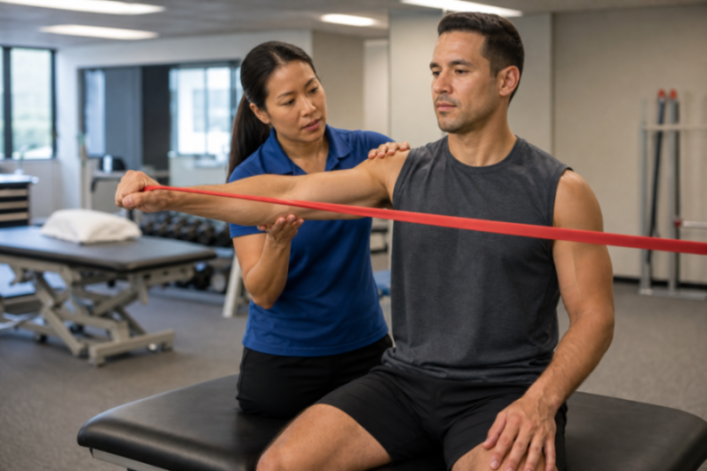
- Therapeutic exercise to rebuild strength, power, endurance and neuromuscular control
- Motor control and movement retraining focused on sport-specific mechanics
- Gradual return-to-sport protocols with objective criteria for progression
- Home exercise programs and education on load management and injury prevention
Coordination with non-surgical and interventional care
Some injuries benefit from combined medical and rehabilitative care. At MK Spine & Joint Rehab we emphasize multidisciplinary management: our team includes pain specialists who provide medication management and a range of image-guided, minimally invasive procedures when clinically appropriate. Procedures such as targeted epidural or facet injections, radiofrequency ablation (RFA) for chronic facet pain, or percutaneous disc decompression for select disc-related symptoms can reduce pain sufficiently to allow more effective participation in physical therapy.
When interventional care is part of your plan, your therapist and treating physician coordinate closely to time treatments and rehabilitation milestones so that injections or ablation facilitate—not interrupt—progress toward functional goals. Learn more about our minimally invasive options here.
Common sports injuries treated in Hauppauge
We see a broad spectrum of sports and activity-related conditions, including:
- Rotator cuff strains and labral irritation
- Patellofemoral pain, meniscal sprains and ACL rehabilitation
- Hamstring and quadriceps strains
- Achilles tendinopathy and ankle sprains
- Low back pain related to disc irritation, facet-mediated pain and radiculopathy
- Overuse conditions such as tendinopathy and stress-related pain
Each diagnosis prompts a different emphasis in rehabilitation—some athletes need more neuromuscular retraining, others require graded tendon loading or a period of activity modification while healing occurs.
Outpatient care designed for local athletes and active adults
Our Hauppauge office provides accessible outpatient care close to home for residents across Suffolk and Nassau counties. Whether you’re returning to weekend recreational leagues or training professionally, therapy schedules and programs are built around realistic timelines and measurable milestones. To find the Hauppauge location and hours, visit our Hauppauge Office page.
When additional diagnostics are needed
If your history or exam suggests nerve compression or a more complex neurologic component, our clinicians can arrange nerve conduction testing/EMG and advanced imaging as appropriate. This diagnostic precision helps us match the right therapeutic interventions to your condition and avoid delays in recovery.
Return-to-play and injury prevention
Return-to-play is not a date on the calendar; it’s a criteria-driven decision. We use objective tests—strength symmetry, hop tests, sport-specific movement analysis and clinician-observed control—to determine readiness. Injury prevention is equally important: we teach load management, progressive volume increases, sport-specific warm-ups and cross-training strategies proven to reduce recurrence.
Working with MK Spine & Joint Rehab
MK Spine & Joint Rehab (Marvin Kalter Spine & Joint, P.C.) blends rehabilitation services with interventional pain expertise for patients who need coordinated non‑surgical care. Our team provides medication management, electrophysiologic testing, image-guided injections, RFA and other minimally invasive options when clinically indicated. Combining these services with targeted physical therapy often improves the ability to participate in and complete a rehabilitation program.
Learn more about our physical therapy services on the practice site: Physical Therapy. For questions or to schedule an evaluation, use our Contact Us page or call to book an appointment at our Hauppauge or Garden City offices.
What to expect at your first visit
Your initial appointment will include a focused history, movement and neurologic exam, and a discussion of realistic short- and long-term goals. We’ll outline a treatment plan, expected timeline, and measurable milestones. If additional testing or interventional consultation is indicated we’ll coordinate that promptly so there’s minimal downtime in your rehabilitation.
Practical tips for athletes beginning rehabilitation
- Bring a list of current medications and any recent imaging or reports.
- Be prepared to demonstrate sport-specific movements so your therapist can assess mechanics.
- Follow prescribed home exercises consistently—rehab progress depends on regular loading and practice.
- Communicate any changes in symptoms after activity so your plan can be adjusted safely.
Getting started
If you’re recovering from a sports injury in Hauppauge, our team offers compassionate, evidence-based care that integrates rehabilitation with interventional options when appropriate. Book an appointment online or call to schedule a consultation at the Garden City or Hauppauge office and begin a plan designed to restore function and minimize future risk.
Schedule now: Visit our Hauppauge Office page or Contact Us to book your first evaluation.
Frequently Asked Questions
How soon after a sports injury should I start physical therapy?
Begin as soon as your physician or therapist advises—often within days for acute soft-tissue injuries when pain and swelling are manageable. Early assessment helps establish baseline function and a safe, progressive plan.
Will I need imaging or nerve tests before starting therapy?
Not always. Your therapist will evaluate you and recommend imaging or nerve conduction testing/EMG when symptoms, focal neurologic findings, or suspected structural pathology indicate the need for further diagnostic clarity.
Can physical therapy help if I’ve already had injections or other procedures?
Yes. In many cases, injections or minimally invasive procedures reduce pain enough to improve participation in rehabilitation. We coordinate therapy timing with interventional treatments to maximize benefits.
How long does sports rehabilitation usually take?
Duration varies by injury severity, body region and individual factors. Minor strains may resolve in weeks; more complex injuries or those requiring gradual tendon loading can take several months. Progress is measured by objective milestones rather than fixed dates.
Do you offer sport-specific return-to-play programs?
Yes. Rehabilitation includes sport- and position-specific drills, functional testing and criteria-based progression to ensure a safe, performance-focused return to activity.
What if conservative care doesn’t relieve my symptoms?
If pain or dysfunction persists, our multidisciplinary team evaluates alternative non-surgical options, including medication management and minimally invasive image-guided procedures, and discusses next steps with you and your referring providers.
How do I schedule an appointment at the Hauppauge office?
You can book online via the Hauppauge Office page or use our Contact Us page to call and schedule a consultation at either the Hauppauge or Garden City location.