Living with spine, nerve or joint pain affects daily life, work and family time. At MK Spine & Joint Rehab (Marvin Kalter Spine & Joint, P.C.), our Hauppauge team provides compassionate outpatient care focused on individualized evaluation and treatment plans. We combine diagnostic nerve testing, medication management, physical and occupational rehabilitation, and image-guided, minimally invasive procedures to help patients reduce pain and return to meaningful activity.
What to expect at your Hauppauge consultation
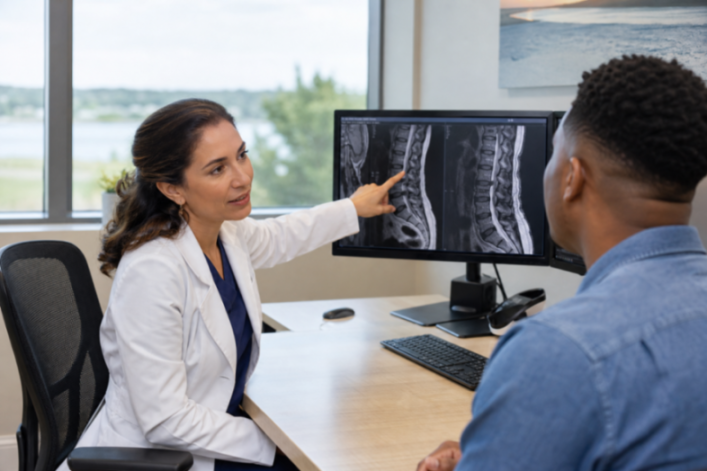
When you arrive for an evaluation for pain management in Hauppauge, our clinicians take a detailed history and perform a focused physical and neurologic exam. We review prior imaging and, when indicated, order or arrange up-to-date studies to pinpoint the source of pain. The goal is to define a clear diagnosis and create a treatment plan that balances symptom relief with restoring function.
Multidisciplinary assessment
Our outpatient model emphasizes teamwork. Physicians experienced in interventional pain management coordinate with therapists and nurses to develop progressive plans that may include diagnostic testing, medication adjustments, exercise‑based rehabilitation and targeted procedures. This collaborative approach helps tailor care to each patient’s needs, comorbidities and activity goals.
Advanced diagnostic testing: nerve conduction studies and EMG
Electrodiagnostic testing (nerve conduction studies and electromyography) can clarify whether symptoms stem from nerve compression, peripheral neuropathy or muscle disorders. MK Spine & Joint Rehab offers in‑office testing so results inform treatment quickly. Learn more about our diagnostic testing and how it integrates into care at Nerve Conduction Testing.
Outpatient, image‑guided minimally invasive procedures
For many patients, targeted and image‑guided interventions deliver meaningful pain reduction while avoiding open surgery. Our practice provides a range of outpatient procedures performed under fluoroscopic or ultrasound guidance to maximize accuracy and safety.
Common image‑guided options
- Epidural and facet injections: Corticosteroid or anesthetic injections can reduce inflammation and identify pain generators. See Spinal Epidurals and Facet Injections for details.
- Radiofrequency ablation (RFA): For facet joint pain, RFA can disrupt pain signals from the joint nerves. Read about our approach at Radiofrequency Ablations.
- Percutaneous disc decompression: For selected patients with contained disc herniation, minimally invasive decompression can reduce nerve compression without open surgery — more at How Percutaneous Disc Decompression Can Relieve Chronic Back Pain.
- Spinal cord stimulation and pain pumps: For refractory pain, neuromodulation with spinal cord stimulators or implanted intrathecal pumps offers another outpatient option. Our team evaluates candidacy and coordinates testing and implantation when appropriate.
- Joint injections and Botox for chronic migraine: Targeted joint injections can relieve arthritic or mechanical pain; Botox is offered for chronic migraine management when clinically indicated.
Medication management within a broader plan
Medications can play an important role in controlling pain, improving sleep and enabling participation in rehabilitation. Our approach to medication management emphasizes safety, regular review and combination with active therapies to maximize function while minimizing risks. For more on our medications approach, see Medication Management.
Rehabilitation to restore function
Active rehabilitation—physical and occupational therapy—is critical for long‑term improvement. Our outpatient programs focus on graded exercise, posture and body‑mechanics training, core stabilization and activity‑specific conditioning. Therapy complements interventions and medications by addressing movement impairments that contribute to recurrence.
Why outpatient care matters
Outpatient management allows patients to recover at home, return to family and work responsibilities quickly, and receive care in a familiar setting. Many procedures at MK Spine & Joint Rehab are same‑day and guided by imaging to reduce complications and improve outcomes. The outpatient pathway also supports close follow‑up: clinicians monitor progress and adjust plans without unnecessary delay.
Who may benefit from our services
We evaluate adults with a broad range of conditions, including chronic low back and neck pain, radiculopathy (nerve root pain), peripheral neuropathies, joint pain from arthritis or injury, post‑surgical persistent pain, work‑ and sports‑related injuries, and chronic migraine. Patients seeking second opinions or nonsurgical alternatives are welcome.
Safety, informed consent and realistic expectations
Every treatment decision is made with informed consent. Clinicians discuss potential benefits, risks and realistic outcomes for each intervention. While many patients experience significant pain reduction and improved function, individual responses vary and no provider can guarantee complete elimination of pain.
Scheduling and locations
MK Spine & Joint Rehab serves Long Island from offices in Garden City and Hauppauge. To schedule at the Hauppauge location or learn more about appointment logistics, visit our Hauppauge Office page. If you prefer a Nassau County appointment, see details for our Garden City office on the site. You can also reach us by phone to book an appointment; book an appointment online or call to schedule a consultation at the Garden City or Hauppauge office.
Working with referring providers
We welcome collaboration with primary care physicians, orthopedists, neurologists and occupational medicine specialists. Our team provides clear reports and coordinates care to help patients progress through conservative, interventional and rehabilitative options.
Patient resources and next steps
Before your visit, you may find useful information in our patient resources and the practice overview. Visit Patient Resources and About to prepare for your appointment. For questions about specific treatments, including minimally invasive options, see our page on Minimally Invasive Procedures and our blog for longer reads on topics such as Interventional Spine Techniques.
Evidence and trusted guidance
Clinical practice supports a multimodal approach to chronic pain that combines education, active rehabilitation, selective interventions and careful medication use. For patient information about electrodiagnostic testing, the American Association of Neuromuscular & Electrodiagnostic Medicine provides helpful resources. Public health summaries on chronic pain offer useful context for patients and clinicians alike (see external resources below).
Make an appointment
If you are seeking outpatient pain management in Hauppauge, our team is ready to listen and build a plan tailored to your goals. Book online or call our office to schedule a consultation at the Hauppauge or Garden City office. Early, coordinated care can improve recovery and help you get back to the activities that matter most.
Frequently Asked Questions
What types of conditions do you treat at the Hauppauge office?
We treat adults with chronic and injury-related spine, nerve and joint pain including low back and neck pain, radiculopathy, peripheral neuropathy, arthritic joint pain, post-surgical pain, work and sports injuries, and chronic migraine.
Do I need imaging before my first visit?
If you have recent imaging (MRI, CT, X-rays), bring it to your appointment. If imaging is outdated or unavailable, we may order or arrange appropriate studies to inform diagnosis and treatment planning.
What is electrodiagnostic testing, and why might I need it?
Electrodiagnostic tests (nerve conduction studies and EMG) assess nerve and muscle function to identify nerve compression or neuropathy. They help pinpoint the source of symptoms and guide treatment choices. MK Spine & Joint Rehab performs in‑office testing when indicated.
Are the procedures you offer performed on an outpatient basis?
Yes. Many of our image-guided procedures — such as epidural and facet injections, RFA, percutaneous disc decompression and certain neuromodulation trials — are performed on an outpatient basis with same‑day recovery protocols.
How does medication management fit into my overall care?
Medications can reduce pain, improve sleep and enable participation in therapy. Our medication management strategy emphasizes safety, periodic review and integration with rehabilitation and interventional options to optimize function.
What should I expect after a minimally invasive procedure?
Recovery varies by procedure, but most patients experience a brief period of observation and then go home the same day. We provide post‑procedure instructions, follow-up plans and rehabilitation recommendations to support recovery.
How do I schedule an appointment at the Hauppauge office?
You can schedule by calling our office or visiting the Hauppauge Office page on our website to find contact details and directions: https://mkspinejoint.com/hauppauge-office/.