
Herniated Disc Treatment in Garden City and Hauppauge, NY
Understand your back or neck symptoms and explore a plan for better movement with Dr. Matthew Kalter.
Get clear answers about disc-related pain
An MRI report that says “herniated disc” can leave you with more questions than answers. Is it causing your pain? Can you keep working? Will you need a procedure? At MK Spine & Joint Rehab, herniated disc treatment starts with a conversation about your symptoms and what you want to get back to doing.
Dr. Matthew Kalter sees patients in Garden City and Hauppauge for spine pain evaluation and nonsurgical care. Bring your questions and any previous records. Your visit is a chance to understand your options and decide on an appropriate next step.
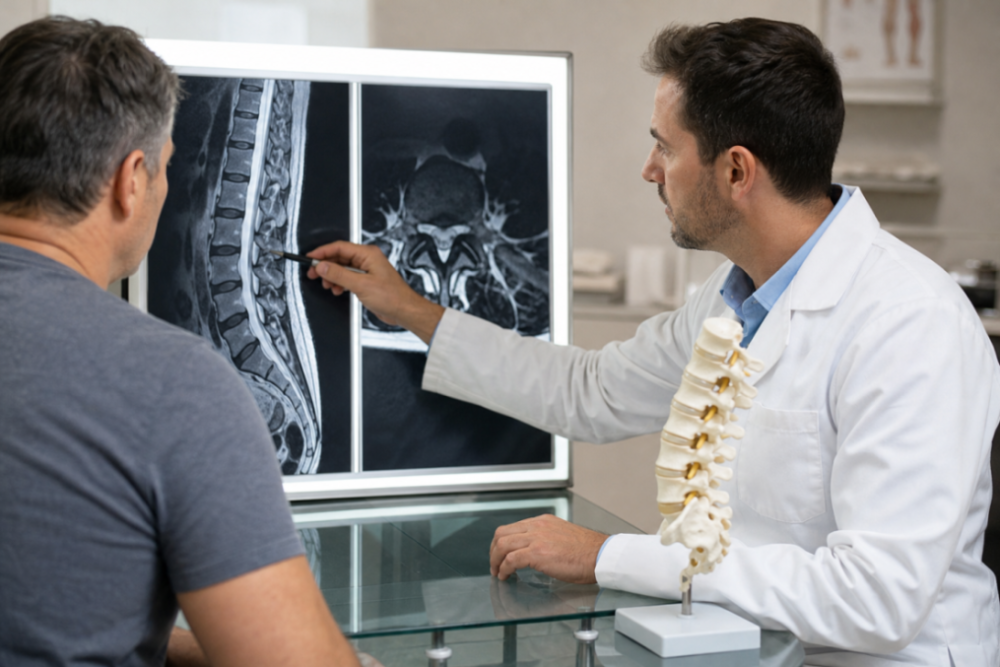
Illustrative consultation image. Dr. Kalter is pictured below.
What is a herniated disc?
Discs are cushions between the bones of your spine. A herniation happens when some of a disc’s softer center pushes through a tear in its outer layer. Nearby nerves can become irritated or compressed, causing pain or changes in sensation.
A bulging disc and a herniated disc are related but different findings. With a bulge, part of the outer disc extends beyond its usual boundary. With a herniation, inner material pushes through the outer layer. Either finding can appear on a scan without causing symptoms, so the report needs to be considered alongside your examination.
What symptoms can a herniated disc cause?
In the lower back: You may have back pain, pain traveling through the buttock into a leg, or tingling, numbness or weakness in the leg or foot. This traveling pain is often called sciatica. Our sciatica treatment page explains that symptom pattern in more detail.
In the neck: An irritated nerve may cause neck or shoulder-blade pain that travels into the arm or hand. Tingling or numbness may also occur. Similar symptoms can have other causes, which is why an examination matters.
How is a herniated disc evaluated?
The evaluation looks at your symptoms, medical history and physical findings together. The doctor may check strength, sensation, reflexes and movement. Describe where the pain travels, when it began and whether your ability to walk, grip or lift has changed.
MRI can show discs and nearby nerves, but it is not automatically needed before a first visit. The examination and course of your symptoms help determine whether imaging would guide treatment. An ordinary X-ray cannot show the herniated disc itself.
Bring existing scan reports, a medication list and notes about treatments you have tried. Our patient resources can help you prepare.
What are the nonsurgical treatment options?
Many people improve without surgery. A plan may combine rehabilitation, appropriate activity changes and medication, with an injection considered for selected patients. Treatment is based on your findings, health history and response to care. No single approach is right for every disc problem.
Physical therapy and movement
Physical therapy can address strength, movement and body mechanics. The exercises should suit your symptoms and current abilities. The aim is to build activity gradually and make everyday tasks more manageable, rather than follow a generic stretching routine.
Medication management
Medication management may help with pain while you work through rehabilitation. Your other medicines and medical conditions affect what is appropriate. Discuss potential benefits and side effects before starting or changing any prescription or over-the-counter medicine.
Epidural injection evaluation
When a disc irritates a spinal nerve, an epidural steroid injection may help reduce inflammation and symptoms. It does not put the disc back in place, and relief varies. Our spinal injection services page explains these procedures. Ask about risks, alternatives and what improvement would mean for you.
A manageable daily routine
Brief rest may help during a painful flare, but prolonged bed rest is generally discouraged. Discuss walking, position changes and a gradual return to activity with your clinician. Let the doctor know if your job involves lifting, driving or long periods at a desk so you can discuss suitable adjustments.
When might surgery be considered?
A surgical opinion may be appropriate when disabling symptoms persist despite nonsurgical treatment or when significant neurological problems develop. New or worsening weakness needs prompt assessment. Emergency symptoms should be evaluated immediately, not put off while trying more treatment.
Our pain management services focus on understanding the source of pain and discussing a plan that fits your situation.

Meet Dr. Matthew Kalter
Dr. Matthew Kalter is a fellowship-trained interventional physiatrist with a background in physical medicine and rehabilitation. His work focuses on pain, movement and everyday function.
During your visit, share what matters most to you, whether that means getting through a workday, sleeping more comfortably or returning to a favorite activity. Clear goals make it easier to discuss treatment choices and follow-up. Learn more about Dr. Kalter and MK Spine & Joint Rehab.
Herniated disc care in Garden City and Hauppauge
Choose the office that works best for your schedule. When requesting an appointment, describe your back or neck symptoms and mention any recent changes in strength or sensation. The scheduling team can confirm availability, insurance participation and referral requirements.
Garden City office
500 Old Country Road, Suite 300
Garden City, NY 11530
Our Garden City location offers a Nassau County option for patients from nearby communities such as Mineola, Westbury and Hempstead.
Hauppauge office
750 Veterans Memorial Highway, Suite 102
Hauppauge, NY 11788
Patients in Suffolk County can request a Hauppauge appointment, including those coming from Smithtown, Commack and Islandia.
Questions About Herniated Disc Treatment
Is a herniated disc the same as sciatica?
No. A herniated disc is a structural change in a spinal disc. Sciatica describes nerve-related pain traveling into the leg. A lower-back disc herniation can cause sciatica, but other conditions can cause it too.
Can a herniated disc improve without surgery?
Yes. Many people improve with nonsurgical care. Recovery varies with the symptoms and examination findings. Persistent disabling pain or neurological problems may require further specialist assessment.
Does every herniated disc on an MRI need treatment?
No. Disc changes can appear on a scan without causing symptoms. The doctor considers the imaging alongside your history and examination before recommending care.
Can I stay active with a herniated disc?
Gentle activity is often part of recovery, but the right amount depends on your symptoms. Ask about movements, work duties and exercise. Stop and seek medical advice for new weakness or worsening neurological symptoms.
Do I need an MRI before making an appointment?
Not necessarily. Bring any imaging and reports you already have. Your history and examination help determine whether additional testing would be useful.
What should I ask during my first visit?
Ask what may be causing your symptoms, which treatment choices fit your situation, what the benefits and risks are, and when to follow up. Confirm which changes should prompt an earlier call or urgent care.
Which symptoms need urgent medical attention?
Go to an emergency department right away for new trouble urinating, loss of bladder or bowel control, numbness around the groin or anus, or severe or rapidly worsening weakness in the legs. Back or neck pain after a serious accident also needs emergency assessment. Do not wait for a routine office appointment.
New or increasing arm or leg weakness, difficulty walking, fever with spine pain, or unexplained weight loss should be assessed promptly. Tell a healthcare professional about these changes when seeking care.
Take the next step toward understanding your pain
You don’t need to choose a treatment before you call. Request a visit with Dr. Kalter to discuss your symptoms, review previous care and understand the options available to you.
Patient education sources
For more information, read MedlinePlus on herniated discs, the American Association of Neurological Surgeons’ patient guide, Johns Hopkins Medicine on lumbar disc disease, and NHS guidance on symptoms and warning signs. Mayo Clinic explains bulging versus herniated discs, and RadiologyInfo describes epidural injections.
This page provides general education and does not replace an individual medical evaluation.